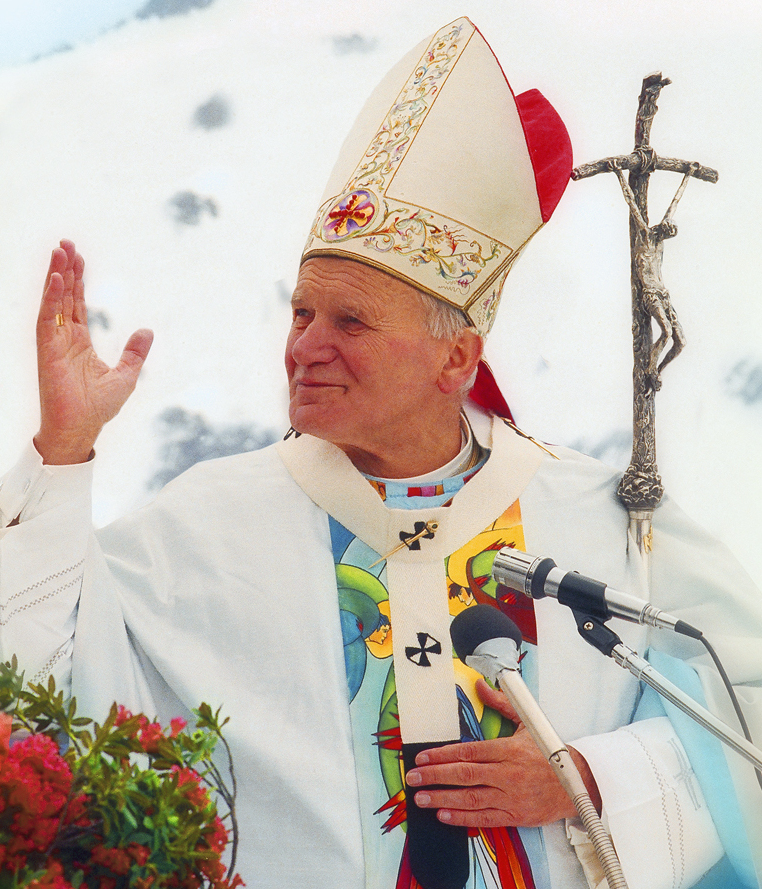
Pope St. John Paul II
Karol Józef Wojtyła
Reign: 16 October 1978 – 2 April 2005
Born: 18 May 1920, Wadowice, Poland
Died: 2 April 2005, Vatican City
Status: 27 April 2014
Motto: Totus Tuus (Totally Yours)
"Be not afraid! Open wide the doors to Christ!"
— Inaugural Homily, 22 October 1978
Personality
The Actor-Poet
Before the priesthood, Karol Wojtyła was an actor in the Rhapsodic Theatre and a published poet. This shaped his entire papacy: he understood the world as stage, gesture, and symbol.
The Philosopher of the Person
His intellectual formation in phenomenology gave him a vocabulary of personalism — the irreducible dignity of the human person, known through experience and encounter.
The Suffering Servant
The assassination attempt (1981) and his long final illness were not interruptions of his ministry but its culmination. He turned suffering into theological witness.
The Marian Devotee
His motto Totus Tuus ("Totally Yours," to Mary) was not ornament but identity. He attributed his survival of the assassination attempt to Our Lady of Fátima.
The Athlete and Outdoorsman
As a young man, he hiked, kayaked, and played soccer. His physical vitality gave him an unusual capacity for travel (104 pastoral journeys).
The Evangelist Without Fear
He confronted communism, consumerism, and the "culture of death." Yet he was also irenic — seeking dialogue with other religions, science, and the modern world.
Spirituality
John Paul II's spirituality was deeply Marian, Carmelite, and Eucharistic. His motto Totus Tuus expressed a life consecrated to Jesus through Mary in the tradition of St. Louis de Montfort. Influenced by St. John of the Cross and St. Teresa of Ávila, his contemplative depth infused every aspect of his dynamic pontificate. He canonized St. Faustina Kowalska and established Divine Mercy Sunday, making Divine Mercy a hallmark of his legacy.
Works & Writings
encyclicals
Apostolic Letters
books
Audiences & Catecheses
Related Themes
Suffering & the Cross
How the three popes illuminate the mystery of human suffering through Christ's redemptive sacrifice.
Prayer & Contemplation
Three distinct yet harmonious paths of prayer: Marian mysticism, liturgical contemplation, and Ignatian discernment.
Human Dignity & Family
The dignity of the human person, the vocation of marriage, and the theology of love across three pontificates.
Faith & Reason
The harmony of faith and reason, against both fideism and rationalism.
Mercy & Compassion
The mercy of God as revealed through the Cross, taught in truth, and offered without condition.
Ecology & Creation
From human ecology to integral ecology: care for creation as moral imperative.
Social Justice
The person at the center of economic life, charity in truth, and fraternity as the foundation of justice.
Liturgy & Beauty
The Eucharist as source and summit, beauty as a path to the mystery, and the liturgy as divine gift.
Mary & the Saints
The Blessed Virgin Mary and the communion of saints as models of holiness for every age.